
The Language of Prayer
Part 5 in the Series, Lord, Teach us to Pray

It happens all the time.
A small group gathers in a living room. Someone sets down their coffee, and after a moment of awkward silence, the leader asks, “Would anyone like to pray?”
Eyes drop. Chairs creak. Everyone suddenly becomes fascinated with their shoes.
The quiet stretches.
It’s not that people don’t want to pray. It’s that they don’t know where to begin.
Some are afraid they’ll say the wrong thing. Others are ashamed — convinced that their words aren’t holy enough, that God might be listening for eloquence rather than honesty. I’ve seen people freeze completely, lips pressed tight, as if afraid to speak aloud what they feel inside.
When I began asking people about this moment — about the fear and awkwardness of prayer — their stories poured out. Some described years of spiritual self-consciousness, afraid to look foolish before others. Others said they had never learned the “right” words.
And as I listened, I realized: the heart of the problem isn’t that people don’t know how to pray. It’s that we’ve forgotten that prayer was never about getting it right. It’s about showing up.
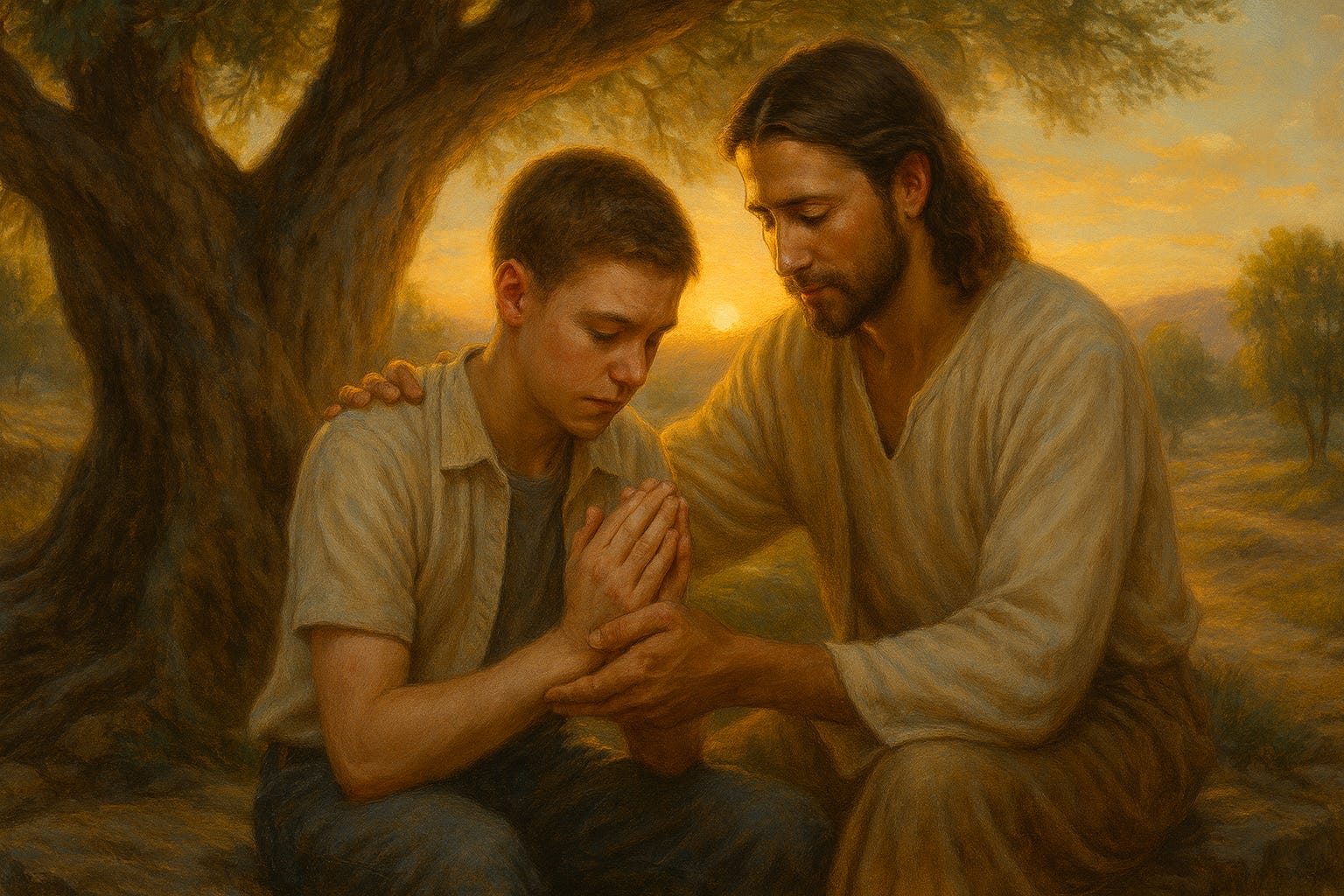
The Psalms: A Record of Imperfect Prayer
If you want to understand prayer in its truest form, look at the Psalms.
They are not a manual on righteous living. They are a record of a man learning to speak to God — and to listen.
David prays when he is brave and when he is broken.
He begs, he complains, he rejoices, he lashes out.
Sometimes his prayers contradict themselves.
“How long, O Lord? Will you forget me forever?” (Psalm 13:1)
“Break the teeth of the wicked!” (Psalm 3:7)
“Create in me a clean heart, O God.” (Psalm 51:10)
These are not the prayers of a saint polished by religion. They are the raw, unfiltered cries of a man caught between fear and faith.
David is called “a man after God’s own heart” — not because he always prays rightly, but because he always returns to God. His prayers mark the slow, uneven movement of a human soul being changed by love.
That, I realized, is the real language of prayer. Not correctness, but relationship.
Case Study 1 — The Beginner’s Prayer
When I met Ryan, he had only recently begun exploring faith. A former paramedic, he had seen too much suffering to believe in anything easily.
“I didn’t grow up praying,” he told me. “When I tried it for the first time, I felt ridiculous. Like I was talking into a void. I didn’t know what to say, so I just said, ‘God, help me.’ That was it.”
He shrugged. “I didn’t even know if I believed He was listening.”
Weeks later, when his father died unexpectedly, Ryan said the same three words again. “It wasn’t eloquent. But it was all I had.”
That’s how prayer begins. Not with mastery, but with need.
David prayed that way, too: “This poor man cried, and the Lord heard him.” (Psalm 34:6)
Prayer’s first language is simplicity — the moment we stop pretending and start speaking honestly.
Case Study 2 — The Performance Trap
Lisa had the opposite problem. She grew up in church, surrounded by people who prayed in long, flowing paragraphs.
“When I prayed out loud, I was mostly thinking about how I sounded,” she admitted. “I’d try to say all the right words — to sound confident, spiritual, articulate. But deep down, I wasn’t really talking to God. I was talking to the room.”
Jesus warned about that kind of prayer: “They love to stand and pray in the synagogues and on the street corners to be seen by others.” (Matthew 6:5)
Lisa said what broke her pattern was exhaustion. “I hit a point in my life when I couldn’t fake it anymore. I remember praying one night, ‘God, I don’t even know how to talk to you right now.’ And for the first time, I think I actually did.”
When prayer stops performing, it starts transforming.
Case Study 3 — The Wordless Prayer
Some stories didn’t even contain words.
When I met Maria, her husband had recently passed away after a long battle with cancer. “I used to pray all the time,” she said. “Then one day I just… stopped. There was nothing left to say.”
She would sit by the window each morning with her Bible open to the Psalms, but she couldn’t read them aloud. “I would just stare at the page,” she said. “I think God understood anyway.”
Paul writes that “The Spirit helps us in our weakness… with groans too deep for words.” (Romans 8:26)
And Psalm 77 confesses, “I remembered God, and I groaned; I meditated, and my spirit grew faint.”
In the language of the mystics, Maria had entered the prayer beyond speech — what The Cloud of Unknowing calls “naked intent directed to God.”
When our words fail, our being prays for us.
Case Study 4 — The Evolving Prayer
Not all prayer begins in crisis. Some grows slowly, ripening with time.
When I met Harold, he was in his seventies — a retired teacher who had been praying daily for decades. “I look back,” he said, “and I see that my prayers changed as I changed.”
He laughed softly. “When I was young, I prayed for success — for my plans to work out, for my kids to turn out right. Now I mostly pray, ‘Thy will be done.’”
The arc of Harold’s life reminded me of David’s: the restless striving of early Psalms giving way to the quiet surrender of later ones.
“My heart is not proud, O Lord,
my eyes are not haughty.
I have calmed and quieted my soul,
like a weaned child with its mother.” (Psalm 131:1–2)
Prayer matures us. It does not always change our circumstances, but it changes what we ask for.
Learning the Language
As I compared these stories — Ryan’s simplicity, Lisa’s honesty, Maria’s silence, Harold’s surrender — I began to see that the language of prayer isn’t a single vocabulary. It’s a living relationship that changes as we do.
The Psalms model this perfectly. They contain fury and tenderness, fear and praise.
They move from “Why have You forsaken me?” to “I will bless the Lord at all times.”
Sometimes, both lines belong to the same psalm. Prayer, like language itself, grows through use. We learn to speak to God by speaking — awkwardly, haltingly, honestly.
As one pastor told me, “God would rather hear a messy prayer from your heart than a perfect one from your mouth.”
The Word Behind Words
The mystics take it one step further.
Teresa of Ávila wrote, “Prayer is nothing else than an intimate sharing between friends.”
And Meister Eckhart said, “God is not found in the noise of words, but in the silence beyond them.”
Even scripture points toward this mystery: “In the beginning was the Word.” (John 1:1)
Every prayer — from the desperate cry to the silent sigh — is a return to that divine Word. We think we are speaking, but in truth, it is the Word speaking through us. Our stammering syllables are caught up in something older, deeper, and more infinite than language itself.
“Lord, Teach Us to Pray”
There’s a quiet moment recorded in the Gospels that may be one of the most revealing in all of scripture.
Luke writes, “One day Jesus was praying in a certain place. When he finished, one of his disciples said to him, ‘Lord, teach us to pray.’” (Luke 11:1)
It’s easy to miss how extraordinary that request really was. The disciples had watched Jesus do things that defied imagination — healing lepers, stilling storms, commanding demons, feeding multitudes.
Yet they never asked, “Lord, teach us to heal.”
They never said, “Teach us how to preach like You do.”
They asked, “Teach us to pray.”
Something about the way Jesus prayed must have been utterly different. They had grown up surrounded by formal prayers — synagogue liturgies, recited psalms, and blessings spoken at mealtime. But Jesus’ prayers were not mechanical or formulaic. They were alive.
When He prayed, something shifted in the atmosphere. Heaven felt near. The disciples must have seen that and thought, whatever that is — that’s what I want.
And so they asked.
The Prayer That Became a Model
In response, Jesus gave them what we now call The Lord’s Prayer — though, perhaps, that name is a little misleading. It could just as easily be called The Disciple’s Prayer, because it wasn’t meant to be His alone. It was given to shape our own words, to orient the heart toward God.
Most scholars agree that Jesus didn’t intend for it to become a rote recitation.
He was offering a pattern, not a script — a framework for authentic relationship.
Each line opens a dimension of prayer that mirrors the full range of human experience — praise, longing, dependence, confession, and trust.
“Our Father in Heaven” — Belonging
The prayer begins with intimacy.
Jesus doesn’t tell them to address God as King, Judge, or even Lord, though He is all of those things. He begins with Father. In that word, Jesus does something revolutionary: He redefines our approach to God.
We are not subjects groveling before a monarch; we are children speaking to a loving parent. Prayer begins not in fear, but in belonging.
To call God “Father” is to remember who we are — and whose we are.
“Your Kingdom Come, Your Will Be Done” — Alignment
Next comes the plea for God’s kingdom to break into the world:
“Your kingdom come, your will be done, on earth as it is in heaven.”
This is not a resignation to fate — it’s an act of alignment. It’s the prayer of those who see the world’s brokenness and long for restoration. Every intercessor, every person who prays for healing, for peace, for justice, is echoing this line.
It’s the moment when our personal desires are lifted into God’s larger purpose — when prayer moves from “my will be done” to “Thy will be done.”
“Give Us This Day Our Daily Bread” — Trust
Then, suddenly, the prayer becomes startlingly ordinary.
After the grandeur of heaven’s kingdom, we are invited to ask for bread. In the world of Jesus’ listeners, bread meant survival — one day’s sustenance at a time. To pray for daily bread is to live without the illusion of control, to trust that God’s provision will be enough for today.
This line gathers up every anxious heart, every person counting bills or waiting for test results.
It is the prayer of those who say, “I don’t know what tomorrow brings, but I believe You’ll meet me there.”
“Forgive Us Our Debts” — Restoration
Prayer inevitably brings us to the place of honesty.
“Forgive us our debts, as we forgive our debtors.”
This is where prayer becomes confession — not as punishment, but as liberation. Forgiveness unburdens the soul, and forgiving others unchains it. To pray this line is to acknowledge both our need and our responsibility: that the grace we receive must also flow through us.
“Lead Us Not Into Temptation” — Guidance
The final petition recognizes human frailty.
We are not as strong as we think. We need guidance to avoid paths that lead to destruction.
“Lead us not into temptation, but deliver us from evil.”
It’s not that God would ever tempt us, but that we ask to be spared from the tests we cannot yet bear. It’s the prayer of humility — of awareness that our dependence on God is constant and kind.
A Prayer That Transforms the One Who Prays
Seen this way, the Lord’s Prayer is less a liturgy to be repeated and more a life to be lived.
It begins with belonging, moves through surrender, and ends with trust. It forms the soul as much as it shapes the words. In a sense, the prayer reveals the pattern of spiritual growth itself — from self to surrender, from fear to faith, from separation to communion.
It is the whole story of sanctification in miniature. Just as the Psalms chart David’s spiritual evolution, this prayer outlines ours.
When we pray it honestly, we’re not performing religion; we’re participating in transformation.
Jesus’ Way of Prayer
Maybe that’s why the disciples were so struck by the way Jesus prayed.
He wasn’t reciting words — He was embodying them.
When He said, “Your will be done,” He lived it in Gethsemane.
When He said, “Give us this day our daily bread,” He broke bread and gave it away.
When He said, “Forgive us,” He offered forgiveness even from the cross.
In Him, prayer became flesh.
He didn’t just teach the language of prayer — He became its living translation.
A Final Reflection
If you’ve ever felt unsure how to begin — if words feel awkward, or silence feels heavy — remember this: the disciples felt that too.
Even those who walked beside Jesus needed to be taught how to pray. And His answer wasn’t a formula. It was an invitation.
Begin with relationship. Ask for God’s kingdom to come. Trust Him for what you need. Tell the truth about your failures. Seek His guidance.
Then rest.
There is no wrong way to pray. Only the humble, beautiful willingness to try.
Adapted from Psalm 51
Create in me a clean heart, O God,
and renew a right spirit within me.
Teach my mouth again to sing,
my tongue again to tell of mercy.
The sacrifice You desire is not perfection,
but a broken spirit —
a heart laid open.
Then I will teach others how to return,
and my words will be praise,
and my silence will be love.
Keep reading with a 7-day free trial
Subscribe to Symbol and Silence to keep reading this post and get 7 days of free access to the full post archives.